Thursday, September 17, 2009

An overly analytical entry

Once I had read Genesis for reading's sake, I decided to go back and skim for authorial changes. Here's what I've found, whether I'm technically 'right' or not, who knows.

Gen. 2:4-I notice a change to the 'J' author. The daily activities are not separated, it's all one story. There are assumptions rather than details, and the sequencing is different.
        Verse 10-14-There's a lot of emphasis on rivers; 'J' gives man much more detailed power
        Verse 24-"Therefore a man leaves his father and his mother and clings to his wife, and they become one flesh."
               * I have heard this verse read at many weddings, but never realized (or paid attention to the fact) that it's from Genesis. It seems as if it should be from the wedding at Cana or a story similar to that one. It feels out of place, especially since they are the first people on the planet, the mother and father of mankind. I guess its context here is that of foreshadowing, to use a literary term :).

Chapter 3-The early part of this chapter makes Eve sound very easily convinced, weak, and like someone who never puts up a fight.
          Verse 6-"...she gave some to her husband, who was with her, and he ate."
  • So he was with her. Ok. Is that translational? Is it metaphorical-was he simply with her in the garden, in a common vacinity, or was he standing right next to her? And if he was standing next to her, he let her do it, and partook as well.
          - Let's say, for argument's sake, that he was standing right next to her, as we are led to believe here. If that's the case, how can it be that God comes down so harshly on Eve? Adam knew just as well as she did that there was a forbidden tree in the middle of the garden. If he was right next to her, he would have seen the serpent, and likely heard him as well. So did Adam just say 'screw it' and decide to eat as well? Did he never question Eve, whom he was supposed to be leading? Was he completely oblivious? Did he not think twice about this random fruit? If he was to know his wife so well, could he not have sensed dishonesty in her?  What I'm saying is this story makes The Fall look entirely like Eve's fault, and looks as if Adam was an innocent bystander. I call b.s. on that. He had just as much knowledge as she did of what was going on, and never stopped her or even thought to question her. He is just as guilty, and it irks me that the fall of humanity is placed on the woman and the guy is aloof and innocent. Sounds all too familiar to the present, and gives fuel to patriarchy. Not only that, but the woman is sentenced to the most excruciating of human pain possible, and the man simply has to irrigate and sweat a little more. Seems grossly unbalanced to me.                    
           -Verse 8 says God was "walking in the Garden." Last time I checked, "all who look upon Him shall die." I'm thinking this is translational/metaphorical as well. Makes for a good story, one that is more plausible for human comprehension.
           -Verse 19-"dust to dust...". I had formerly assumed that this famous phrase was stated at the creation of Adam, and was more of a sign of cyclical life. I'm surprised it is where it is, especially in the context of punishment.
          -Verse 20-This one to me indicates an authorial shift, and seems very out of place. It feels like it should be in the section of Adam's naming of the animals, and the creation of Eve.
          -Verse 22-feels like 'P' author
       

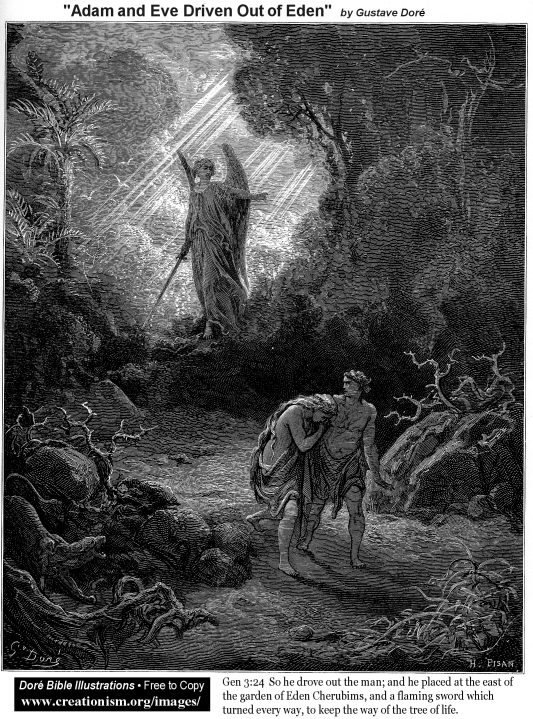
-Verse 24-I really don't recall ever hearing about an angel and a flaming sword. It's a pretty significant verse, too. And this would be a Biblical ignoramus moment.


Chapter 4-Verse 5-Why didn't God have any regard for Cain's offering?
             -Verse 12-Cain is given the same land curse as his father
             -Verse 25-This seems a bit random and out of place. It indicates to me a possible authorial shift. Adam and Eve have Seth to replace Abel, but this story comes in after the telling of 5 generations beyond Cain. Seems strangely out of place.

Chapter 5:1-2- Sounds like 'P', repeating and filling in details 'J' left out.

Geneology:

  • Adam: 130 yrs old, has Seth, then lives another 800 yrs, lives a total of 930 yrs.
  • Seth: 105=Enosh, then 807 yrs, 912 total yrs
  • Enosh 90=Kenan, then 815 yrs, 905 total yrs
  • Kenan 70=Mahalalel, then 840 yrs, 910 total
  • Mahalalel 65=Jared, 830, 895
  • Jared 162=Enoch, 800, 962
  • Enoch 65=Methuselah, 300, 365
I have always wondered if these are actual numbers, or more like total years of bloodlines, with the oldest son or heir mentioned by name. It doesn't seem humanly possible to have children after so long. But maybe that also suggests the amount of change humankind has had over time.
        -Verse 22-24-There are additions here that weren't present with the other names. To me, this indicates authorial change, or was included because Methuselah would later have his own story of mention.
        -Verse 29-Again, additions when it comes Noah. A signifier of his importance to the story. The authors embellish upon those who are the bigger contributors to the overall story(ies)
        -Verse 31-Lamech was 777 years old when he had Noah. This seems interestingly intentional, considering that 7 and 777 are very significant Biblical numbers.

Chapter 6:2-Apparently monogamy was not a precedent. I guess I knew this, but hadn't really acknowledged it until now.
       -Verse 4-The Nephilim- sounds like classical mythology to me, which of course doesn't seem to fit in my mind, so I had to investigate. The footnotes didn't really tell me much, so I wikied it, and what I have come to is that they were especially heroic men, likened to God(s) due to their particular prowess, bravery, nobility, and possibly something as simple as height. Sounds to me like a rationale for extra-ordinary human beings. Possibly what Goliath may have been?....
      -Verse 6-7-I'm shocked that it actually says God was SORRY to have created humans. That's a quality I had never attributed to God before. But in thinking further about it, if humans were made in His image and likeness, it makes sense that God would have some form of regret. Maybe this is where Catholic guilt got started...if God was sorry to have created something so awful, then it should follow that humans should live their lives in perpetual regret and guilt. Just a thought.
    -Verse 9-22-Very redundant, very 'P'

Chapter 7-authorial shift, repetition of prior verses.
           -Verse 2-3- 7pairs of each-again the #7 comes up, and again in verse 4, as well as the # 40, another significant Biblical #
           -Verse 6-contradictory. It says Noah is 600 yrs. old, but in 6:3 God had limited his days to 120. I assume this is a difference in authors, especially since different parts of the Bible were written at different times in history. This verse feels like 'J'
          -Verse 11-16-feels like 'P'. It's like a reversal of Creation, which I find to be really interesting
          -Verse 17 seems to go back to 'J'
Chapter 7 seems to be filled with multiple authors, or at least P & J alternating quite a bit

Chapter 8:7-I don't recall any birds hovering the post-flood earth. It is worded as if the raven failed and the dove succeeded, which is a very interesting notion. Black versus light, a very significant metaphor throughout all literature. I find it pretty awesome that it's in the Noah story. I didn't realize that was one of the first more subtle literary representations of the dichotomy.
       -Verse 11-I didn't know the dove with the olive leaf was from the Noah story. It makes sense though-signs of life. I have always associated the dove carrying the olive leaf with Christmas. It's always been to me a sign of peace. I'm intrigued by the fact that this is where it is in the Bible. That's pretty cool.
     -Verse 13-19 seem like 'P', and it looks like a possible shift @ 20

Chapter 9:5-'eye for an eye' idea. Didn't know it was first presented in Genesis, and I didn't know God mentioned a "reckoning". So it would seem that the idea of capital punishment comes starkly, directly from the Bible. Now that is something I would not have thought of! I knew the 'eye for an eye' idea contributed to the idea of capital punishment, but it almost seems as if verse 5 is the very basis of capital punishment. That seems very counter-intuitive, and I must say it bothers me  a good amount.
        -Verses 5&6 say the same thing, just differently, indicating 2 different authors
       -Verse 9-11-repeat of 8:21
       -Verse 12-17-I didn't know the rainbow was a sign of the coventant with Noah. I'll never look at a rainbow the same again. Also, these verses are different authors mingled together


"GOOD BOOK"

Page 11-I like that Plotz criticizes Adam for letting Eve take the hit for a sin they both committed. Like I said before....

Page 11 (ch. 6-10)-I find it interesting that Plotz questions God's decision to decimate humanity. His previous 2 entries discussed 2 major, unpunished sins, yet somehow Plotz is surprised by God's decision to rid the earth of such "wickedness"? Are such sins reallly that easy to forget, especially since they seemed to astound him so much?

Page 12-Plotz finds it interesting that Noah sacrificed Earth's only living animals, but consider this: what else would he sacrifice? A different food source? Maybe. But an animal really was a true sacrifice for Noah. It's not like God couldn't instantly create more animals, but He purposely didn't. It was a physical sign of loss, of giving back to God in a way that was a sacrifice to both parties.

-"This is just the first of many Bible stories about children disappointing their parents and parents embarrassing their children."
           -That's why it's applicable. That's what makes it a good, relatable story. Audience engagement here. And God's children embarrass and disappoint Him throughout His/their story. And He does it back. If humans didn't do the same, hey wouldn't understand God, wouldn't fit into the 'image and likeness' idea. Mankind's mistakes have to be made real within the story in order to make them applicable.

**So in skimming my entry, I realize it was very long! I think I'm reading a little too closely! No wonder I'm still in Genesis. As of this entry, I will consolidate, not read with quite so much detail, and hopefully get through it much faster. I guess blogging did teach me something!

Thursday, September 10, 2009

Genesis 1&2

  • Genesis 1:26-"Let us make humans in our image, according to our likeness...". So the notes suggest a hint at other deities present but not involved, as well as suggesting God's early intent/implication of a kingly ideal in humans, a form of dominion. God's earthly expression of Himself.  And humans do create and pro-create.

Therefore, my thought is that the intention and delivery of this order started out well, but human greed, curiosity, and addiction that is power, convoluted everything, as usual. This may sound just like regurgitation, but I'm saying that I hadn't really taken into account before that God's first 2 commands to humans, at the moment of Creation (multiply, have dominion), were the very 2 that later became the most destructed.
              -V.28-"Be fruitful and multiply, and fill the earth and subdue it; and have dominion over the fish...and birds...and every living thing that moves upon the earth."  Basically, sex and greed were present from the literal beginning, and it didn't take long at all for humans to screw it up. I knew these had been the commands, but until I thought long-term, I hadn't realised how botched humans have been since the moment we began. In reading further, I'm realising these mistakes repeat themselves time and time again, though they may manifest themselves differently depending on the story. I had previously seen Genesis as its own playing field, with catastrophically unique stories, but I now realise they are just different versions of those woven throughout the Bible. Genesis has long been on a pedestal in my mind, likely because of my education, but I now realise it's a gathering of many-told Biblical stories.

------------------

  • Gen. 2:7-I love this verse. "Then the Lord God formed man from the dust of the ground, and breathed into his nostrils the breath of life; and the man became a living being."
                 -I love this passage. I always see it. This innocent creature lying on his back on the earth he was made from, eyes closed, and God breathes into him in this serene scene, and Adam's chest expands, he opens his mouth, breathes deeply in, and calmly opens his eyes. So simple, and so very beautiful.


"GOOD BOOK"

  • Introduction-"I say the Lord's name only to take it in vain." This reminds me of working at a church carnival, and one of the guys from our church asked 2 little kids if they had heard of Jesus Christ. They replied, "Yeah. It's what people say when they're mad at each other."

  • Dinah...defending your sister's honor. Being a women's studies minor, I think about male-female interaction on multiple levels. I'm very intrigued that the ideas of masculine leadership and protection of women came directly from our beginning, from Genesis. I guess I always knew this, but hadn't really applied it to the 'men are pigs' rule I so often run into. I guess it's NOT all men's fault! It's what they were taught from the beginning, by God. They were simply following orders, a common male, militaristic, protectorate theme. Makes a lot more sense and is much easier to digest now. And yet another reason NOT to be a fem-Nazi.

  • Page 5- "Good Book" is unlike the Bible in one very significant way: you can, without feeling guilty, keep it in the bathroom."
                -Nothing is funnier than the truth! I for so long had it pounded into my head that the Bible was so sacred it couldn't so much as be dropped on the ground or you'd burn in Hell. Once we hit high school our religion teachers were a little more human, okaying and actually promoting writing in our Bibles. But I still only wrote in my school copy, and never in my personal copy (probably mainly due to the fact that I didn't read that one very often). It was as if the uplifted veil applied only within the confines of what "the brothers" approved. The Bible in the bathroom. Definitely off limits. There's guilt, then there's religious guilt, then there's Catholic guilt. The rumors are true. And those who have been to religious school could tell you without question just how much of an abomination it would be to have a Bible in the bathroom. After all, you might as well just defecate on Jesus' face.

    Biblical Ignoramus

    Plotz, Page 2, Good Book

    -On the story of Dinah- "...the tale of Dinah isn't hiding...It is smack in the middle of Genesis, the one book of the Bible even ignoramuses think they know."
                     -I got quite the chuckle out of this line. Having gone to Catholic School I don't recall ever reading this story. It's quite easy for one to think they simply "know" Genesis, even without having read it, simply because so much 'big stuff' happens within it. And in so many ways, the ignoramus part is very true. And I am now officially one of them. I've long known I was, but have gotten away with it because I knew all the major stories and had read and studied more of the Bible than most of my public school friends. But Plotz made me face facts. I am a Biblical ignoramus. Maybe it's because so much of the Bible was thrown at me for so long, I no longer absorbed it after a while. I ignored much of it, able to sail through the umpteen religion classes with answers like God, Mary, saint, Pope, Vatican, Rome, Peter, and the like. Review the notes, do community service, sing in chapel, and dress up on Mass day. A+ methodology right there!


    And to enlighten some of y'all on the (my) Catholic school experience:

    PRAYER and pledge over the intercom in home room every morning. And prayer again at the end of the day. The Catholic church appoints a passage/verse to every day of the year, so guess what! New passage today...and tomorrow...then another one...Needless to say, they didn't get absorbed very often. And I suppose it didn't help that I was consistently (very consistently) late for almost every day of high school.

    So religion class. I went to CCD-I still think it stands for Catholic Catechism Dumb-through 4th grade, the entirety of my public school life. CCD involved the fun Sunday school stuff (flannel boards and the like), with realistic application added where possible, and a snack at every meeting. I remember a few things about CCD: the books we had to fill out, the sterile room in the basement of the church, snacks, being Pontius Pilate in our own rendition of the Crucifixion, and the ridiculously long and agonizing preparation for a sacrament I didn't understand (First Communion). 5th grade saw me at St. Francis Intermediate.

    Then junior high. The former-nun (emphasis on former) couldn't answer dogmatic questions, still believed pre-Vatican II teachings, and had us meditate in the music room once a week (which meant having a really great nap). She had left the sisterhood because the vow of lifelong celibacy didn't quite agree with her, and she had a crush on a man named Weldon (like a steak). See where I'm going with this? So being that my Irish heritage seems to be somehow more genetically expressed in myself than others, I fought religion religiously with her. And won most of the time. Hence the mental wall of an impressionable tween.

    High school. Started out with a religion teacher just out of college. A religion teacher who actually knew what it meant to have a sense of humor! And had good taste in music! And spoke our teen language! Hallelujah! It began sinking in. I guess there's just something about relating Catholicism to U2 that does it for a person. And the teachers throughout the rest of high school actually knew their stuff, believed it, and knew exactly WHY they believed it. Refreshing indeed. That said, my faith grew exponentially by the end of high school, mainly due to the Search (an intense religious retreat). I heard the parts that I wanted to hear and could apply, and let the others bounce off. I was, after all, a teenager.

    So in all of that jumble, many small nuances of the Bible were lost to me, or never taught. I know the big stories and the basics of this complex piece of literature that happens to house the groundwork of my faith. But the basics are just the basics. And I am therefore a Biblical ignoramus.