Gen. 2:4-I notice a change to the 'J' author. The daily activities are not separated, it's all one story. There are assumptions rather than details, and the sequencing is different.
Verse 10-14-There's a lot of emphasis on rivers; 'J' gives man much more detailed power
Verse 24-"Therefore a man leaves his father and his mother and clings to his wife, and they become one flesh."
* I have heard this verse read at many weddings, but never realized (or paid attention to the fact) that it's from Genesis. It seems as if it should be from the wedding at Cana or a story similar to that one. It feels out of place, especially since they are the first people on the planet, the mother and father of mankind. I guess its context here is that of foreshadowing, to use a literary term :).
Chapter 3-The early part of this chapter makes Eve sound very easily convinced, weak, and like someone who never puts up a fight.
Verse 6-"...she gave some to her husband, who was with her, and he ate."
- So he was with her. Ok. Is that translational? Is it metaphorical-was he simply with her in the garden, in a common vacinity, or was he standing right next to her? And if he was standing next to her, he let her do it, and partook as well.
-Verse 8 says God was "walking in the Garden." Last time I checked, "all who look upon Him shall die." I'm thinking this is translational/metaphorical as well. Makes for a good story, one that is more plausible for human comprehension.
-Verse 19-"dust to dust...". I had formerly assumed that this famous phrase was stated at the creation of Adam, and was more of a sign of cyclical life. I'm surprised it is where it is, especially in the context of punishment.
-Verse 20-This one to me indicates an authorial shift, and seems very out of place. It feels like it should be in the section of Adam's naming of the animals, and the creation of Eve.
-Verse 22-feels like 'P' author
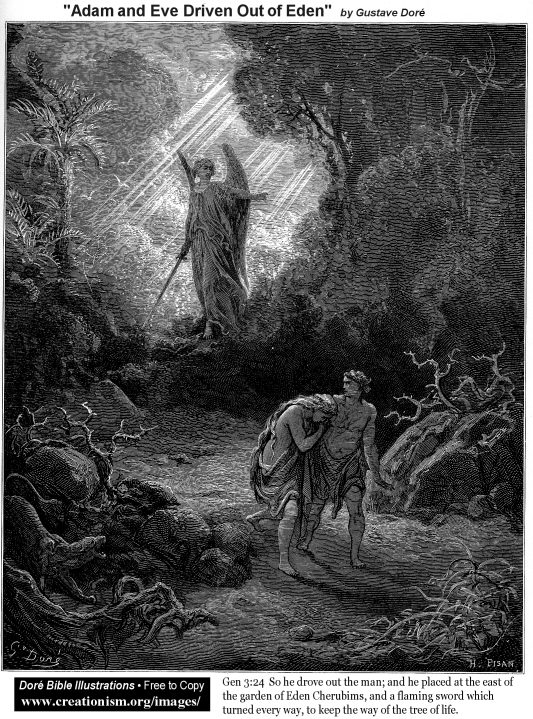
-Verse 24-I really don't recall ever hearing about an angel and a flaming sword. It's a pretty significant verse, too. And this would be a Biblical ignoramus moment.

Chapter 4-Verse 5-Why didn't God have any regard for Cain's offering?
-Verse 12-Cain is given the same land curse as his father
-Verse 25-This seems a bit random and out of place. It indicates to me a possible authorial shift. Adam and Eve have Seth to replace Abel, but this story comes in after the telling of 5 generations beyond Cain. Seems strangely out of place.
Chapter 5:1-2- Sounds like 'P', repeating and filling in details 'J' left out.
Geneology:
- Adam: 130 yrs old, has Seth, then lives another 800 yrs, lives a total of 930 yrs.
- Seth: 105=Enosh, then 807 yrs, 912 total yrs
- Enosh 90=Kenan, then 815 yrs, 905 total yrs
- Kenan 70=Mahalalel, then 840 yrs, 910 total
- Mahalalel 65=Jared, 830, 895
- Jared 162=Enoch, 800, 962
- Enoch 65=Methuselah, 300, 365
-Verse 22-24-There are additions here that weren't present with the other names. To me, this indicates authorial change, or was included because Methuselah would later have his own story of mention.
-Verse 29-Again, additions when it comes Noah. A signifier of his importance to the story. The authors embellish upon those who are the bigger contributors to the overall story(ies)
-Verse 31-Lamech was 777 years old when he had Noah. This seems interestingly intentional, considering that 7 and 777 are very significant Biblical numbers.
Chapter 6:2-Apparently monogamy was not a precedent. I guess I knew this, but hadn't really acknowledged it until now.
-Verse 4-The Nephilim- sounds like classical mythology to me, which of course doesn't seem to fit in my mind, so I had to investigate. The footnotes didn't really tell me much, so I wikied it, and what I have come to is that they were especially heroic men, likened to God(s) due to their particular prowess, bravery, nobility, and possibly something as simple as height. Sounds to me like a rationale for extra-ordinary human beings. Possibly what Goliath may have been?....
-Verse 6-7-I'm shocked that it actually says God was SORRY to have created humans. That's a quality I had never attributed to God before. But in thinking further about it, if humans were made in His image and likeness, it makes sense that God would have some form of regret. Maybe this is where Catholic guilt got started...if God was sorry to have created something so awful, then it should follow that humans should live their lives in perpetual regret and guilt. Just a thought.
-Verse 9-22-Very redundant, very 'P'
Chapter 7-authorial shift, repetition of prior verses.
-Verse 2-3- 7pairs of each-again the #7 comes up, and again in verse 4, as well as the # 40, another significant Biblical #
-Verse 6-contradictory. It says Noah is 600 yrs. old, but in 6:3 God had limited his days to 120. I assume this is a difference in authors, especially since different parts of the Bible were written at different times in history. This verse feels like 'J'
-Verse 11-16-feels like 'P'. It's like a reversal of Creation, which I find to be really interesting
-Verse 17 seems to go back to 'J'
Chapter 7 seems to be filled with multiple authors, or at least P & J alternating quite a bit
Chapter 8:7-I don't recall any birds hovering the post-flood earth. It is worded as if the raven failed and the dove succeeded, which is a very interesting notion. Black versus light, a very significant metaphor throughout all literature. I find it pretty awesome that it's in the Noah story. I didn't realize that was one of the first more subtle literary representations of the dichotomy.
-Verse 11-I didn't know the dove with the olive leaf was from the Noah story. It makes sense though-signs of life. I have always associated the dove carrying the olive leaf with Christmas. It's always been to me a sign of peace. I'm intrigued by the fact that this is where it is in the Bible. That's pretty cool.
-Verse 13-19 seem like 'P', and it looks like a possible shift @ 20
Chapter 9:5-'eye for an eye' idea. Didn't know it was first presented in Genesis, and I didn't know God mentioned a "reckoning". So it would seem that the idea of capital punishment comes starkly, directly from the Bible. Now that is something I would not have thought of! I knew the 'eye for an eye' idea contributed to the idea of capital punishment, but it almost seems as if verse 5 is the very basis of capital punishment. That seems very counter-intuitive, and I must say it bothers me a good amount.
-Verses 5&6 say the same thing, just differently, indicating 2 different authors
-Verse 9-11-repeat of 8:21
-Verse 12-17-I didn't know the rainbow was a sign of the coventant with Noah. I'll never look at a rainbow the same again. Also, these verses are different authors mingled together
"GOOD BOOK"
Page 11-I like that Plotz criticizes Adam for letting Eve take the hit for a sin they both committed. Like I said before....
Page 11 (ch. 6-10)-I find it interesting that Plotz questions God's decision to decimate humanity. His previous 2 entries discussed 2 major, unpunished sins, yet somehow Plotz is surprised by God's decision to rid the earth of such "wickedness"? Are such sins reallly that easy to forget, especially since they seemed to astound him so much?
Page 12-Plotz finds it interesting that Noah sacrificed Earth's only living animals, but consider this: what else would he sacrifice? A different food source? Maybe. But an animal really was a true sacrifice for Noah. It's not like God couldn't instantly create more animals, but He purposely didn't. It was a physical sign of loss, of giving back to God in a way that was a sacrifice to both parties.
-"This is just the first of many Bible stories about children disappointing their parents and parents embarrassing their children."
-That's why it's applicable. That's what makes it a good, relatable story. Audience engagement here. And God's children embarrass and disappoint Him throughout His/their story. And He does it back. If humans didn't do the same, hey wouldn't understand God, wouldn't fit into the 'image and likeness' idea. Mankind's mistakes have to be made real within the story in order to make them applicable.
**So in skimming my entry, I realize it was very long! I think I'm reading a little too closely! No wonder I'm still in Genesis. As of this entry, I will consolidate, not read with quite so much detail, and hopefully get through it much faster. I guess blogging did teach me something!

No comments:
Post a Comment